

Whether you are an experienced HOA Board Member or a newly appointed Property Manager, you have the responsibility of ensuring financial transparency and accountability within your association.
This comprehensive guide will equip you with the knowledge and necessary steps to conduct successful HOA audits.

The Importance of HOA Audits
HOA Audits are important for maintaining the financial health and integrity of your community. They help you ensure that your association’s financial records and operations are accurate, compliant, and transparent.
While on the topic of financial transparency, audits provide HOA members with reassurance that their dues and assessments are handled with the utmost care and accountability. They also protect against potential fraud or mismanagement, promoting trust and confidence among homeowners.
Remember, as an HOA board member or manager, you hold the power to foster financial transparency and accountability within your association.
Who Conducts HOA Audits
These audits are carried out by two primary entities: the HOA board (internal audits) and Certified Public Accountants (CPAs) or auditors (external audits).
Internal Audits: Conducted by the HOA Board
This process allows the board to closely evaluate its financial transactions and make sure that all records are accurate and align with its financial statements.
An internal audit provides the board with an opportunity to identify and correct financial discrepancies or irregularities in a timely manner.
However, it is worth mentioning that internal audits may overlook certain issues due to biases. The board members may be so involved in the operations that they may not identify potential errors or fraudulent activities.
External Audits: Conducted by a CPA or Auditor
To prevent potential biases and ensure a thorough, objective review of the financial records, external audits are strongly recommended.
External audits are conducted by independent CPAs or professional auditors. These experts bring a fresh, unbiased perspective to the financial review process and review the HOA’s records for any signs of mismanagement, fraud, or non-compliance.
The results of an external audit can give HOA members confidence in the association’s financial management, fostering trust within the community.
HOA Audit Checklist
In order to prepare yourself for a financial audit, you should gather many documents from the preceding year. Having these documents is very important because they will provide you and your HOA management with a clearer understanding of the organization’s current status.
All HOAs must possess a specific set of documents known as “governing documents”, that outline the HOA’s rights under the law. They also establish the rules and regulations that all HOA members must follow.
The governing documents consist of several components. Below, we will discuss these documents in order of importance.
Federal/State Law
At the top of the pyramid, we have federal and state laws—no surprises there!
Just like everyone else, HOAs have to play by the rules set forth by these laws.
It’s pretty straightforward: the Federal Law takes the lead, followed by the State Law, and then the local laws that apply to your specific area.
If an HOA defies the law, it could spark a major clash between the organization and the community it serves.
Let’s say, for example, the HOA starts discriminating based on religion or gender, which is a direct violation of the Fair Housing Act… It’s going to stir up conflict and potential litigation.
So, it’s important for HOAs to stay on the right side of the law and avoid any unnecessary headaches. An example is the Condo Website Law update passed in Florida for 2026, which requires condos with 25 or more units to maintain a website with a secure portal for residents. To comply with this law, click below to learn more about our great software management solution, which includes a free Website.

Declaration of Covenants, Conditions, and Restrictions (CC Rs)
This declaration provides an extensive overview of homeowners’ rights and the specific roles assigned to each member of the HOA.
Articles of Incorporation
In an HOA, the articles of incorporation serve as the main source of information about the association. These documents contain details such as:
- The HOA’s name
- Its declaration as a non-profit organization
- The individuals authorized to govern within the HOA.
In addition, the articles of incorporation provide information on eligible voters and specify the individuals authorized to assume leadership roles within the HOA.
HOA Bylaws
The final document on our list is the HOA bylaws.
The purpose of these bylaws is to outline how the HOA is managed by its members. They also define the HOA’s organizational structure for the community.
These bylaws are very important because they describe how the actions and decisions of the HOA board members affect the entire community.
Once you have gathered all these documents and arranged them in the proper order, you can move on to the remaining documents, which lay on the financial side, let’s discuss these next.
Financial Records
Moving forward on your HOA audit, you should obtain a comprehensive set of the organization’s financial records. In many cases, HOAs undergo multiple financial audits throughout the year, which simplifies the process of gathering these documents.
The HOA’s financial records play a crucial role in assessing the organization’s overall financial well-being.
Taxes
One of the most important areas a CPA or auditor will examine in a financial audit is the HOA’s taxes.
Since taxes must be filed by a certain deadline, usually April 15th, most organizations choose to file their taxes early to have them ready for the annual audit.
One of the things an auditor must review in the tax section is whether the accounting records accurately reflect the HOA’s spending, annual budget, revenue, and tax returns. They must also review and ensure that all appropriate documents and forms, like form 1120 H, have been filled out and submitted correctly.
Once all of the financial records are in place, you can move on to the next set of documents that you will need for your HOA audit.
Meetings
The last important step in an audit is to plan the annual meetings.
Since there are so many factors in these meetings, it is crucial to keep an up-to-date record of them and ensure that the entire association is aware of what is happening.
How to Conduct an HOA Audit
Performing an HOA audit doesn’t have to be an overwhelming task. Let’s break down the process into clear, manageable steps so you can ensure a smooth, effective audit!
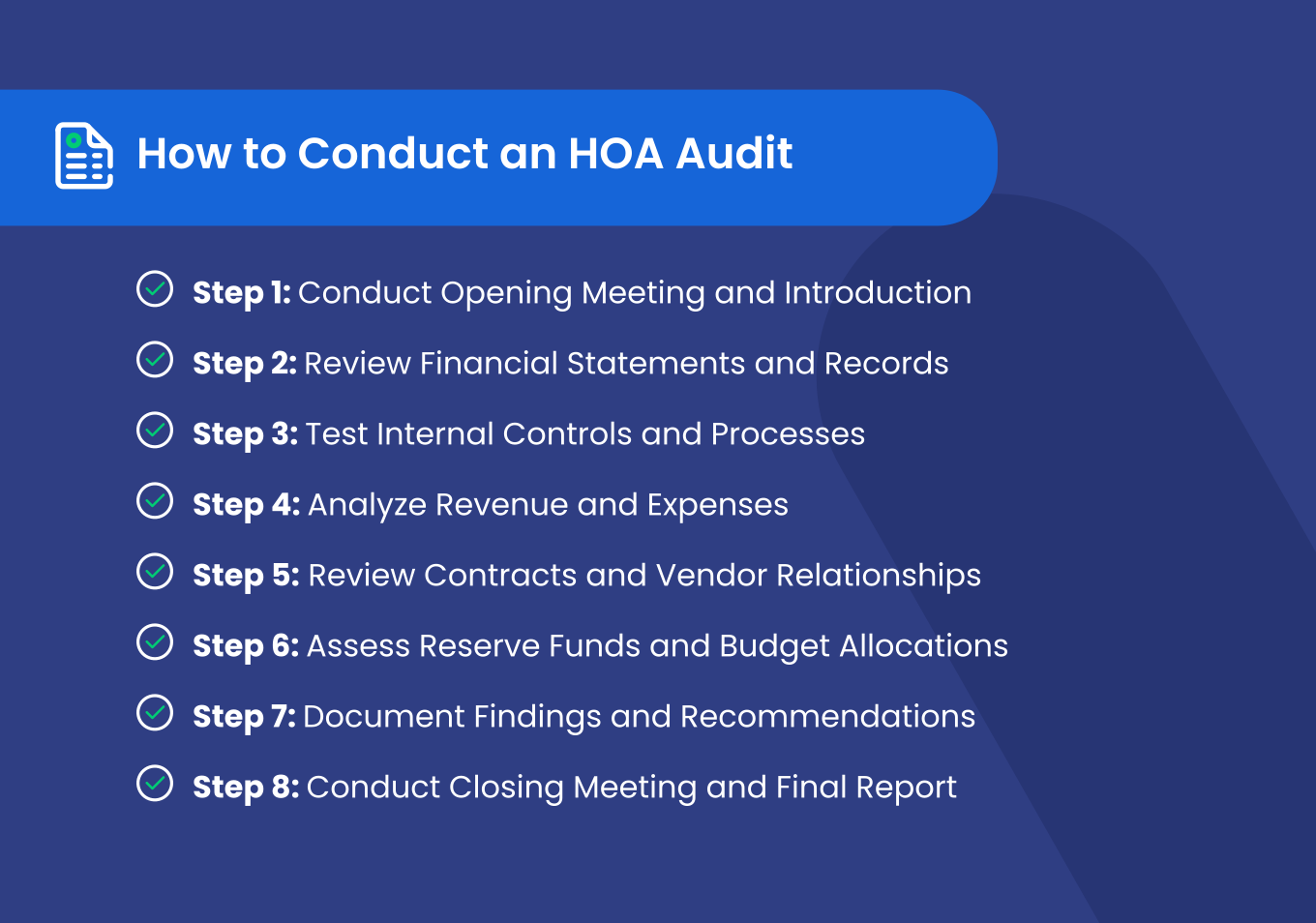
Step 1: Opening Meeting and Introduction
Begin the audit process with an opening meeting.
This meeting serves as an opportunity to introduce the audit team to the HOA board members and managers. During this meeting, you should:
- Establish clear communication channels
- Discuss the audit objectives
- Outline the timeline and expectations
Step 2: Reviewing Financial Statements and Records
Analyze the balance sheet, income statement, cash flow statement, and any other relevant financial documents. Focus on accuracy, completeness, and adherence to accounting standards.
Step 3: Testing Internal Controls and Processes
Test the effectiveness of financial controls, including segregation of duties, authorization procedures, and documentation practices. Identify any weaknesses or areas for improvement and be completely transparent.
Step 4: Analyzing Revenue and Expenses
In this step, you should compare actual figures with budgeted amounts to identify any discrepancies or irregularities. Look for any unusual trends or significant deviations that require further investigation.
Step 5: Reviewing Contracts and Vendor Relationships
Review the terms and conditions, pricing agreements, and performance records. Ensure compliance with contract terms and evaluate vendor pricing.
Step 6: Assessing Reserve Funds and Budget Allocations
Verify that the reserves are adequately funded and utilized in accordance with the association’s governing documents. Assess whether the budget allocations are appropriate and identify any potential financial risks.
Step 7: Documenting Findings and Recommendations
Document your findings, observations, and recommendations throughout the audit process, and maintain clear, organized records of your assessments, supporting evidence, and suggestions for improvement. This documentation will serve as a valuable resource for the HOA’s future financial management.
Step 8: Closing Meeting and Final Report
Present the audit findings, recommendations, and any necessary corrective actions to the HOA board members and managers. Emphasize the importance of implementing the suggested improvements for enhanced financial transparency and accountability.
In the final report, summarize the audit process, key findings, and recommendations in a clear and concise manner. Provide actionable insights that can guide the HOA’s financial decision-making and contribute to its long-term success.
It is worth noting that hiring an independent auditor for your HOA audit offers numerous advantages, including unbiased, objective evaluations. The expertise and objectivity of an independent auditor can instill confidence in the audit process and the accuracy of the results, so keep this in mind when you have to conduct your next audit!
Frequently Asked Questions on HOA Audits (FAQ)
1. What is an HOA audit?
An HOA audit is a detailed review of the association’s financial records and operations. The goal is to verify that financial statements are accurate, funds are properly managed, and the association complies with laws and governing documents.
2. Who performs an HOA audit?
HOA audits can be conducted internally by the board or externally by a Certified Public Accountant (CPA) or professional auditor. External audits are often preferred because they provide an independent and unbiased review of the association’s finances.
3. What documents are needed for an HOA audit?
Common documents include governing documents, financial statements, tax returns, meeting minutes, contracts, vendor agreements, and bank records. These documents help auditors understand how the association is managed and how money is handled.
4. How often should an HOA perform an audit?
The frequency depends on the association’s governing documents and state laws, but many HOAs conduct audits annually. Regular audits help maintain transparency and catch financial issues early.
5. What happens after an HOA audit is completed?
After the audit, the auditor provides a report summarizing findings, identifying any financial risks, and recommending improvements. The board should review the report carefully and implement any necessary corrective actions.
Wrapping Up On HOA Audits
Conducting an HOA audit is not easy, but after reading this article, you are one step closer to embarking on this journey.
Ready to simplify your HOA management? Book your free demo today and experience the power of seamless communication, document management, and resident engagement with Neigbrs.