



Most people volunteer for the HOA board because they genuinely care about their community. Probably you had the experience of sitting through a disorganized annual meeting where you saw a list of unsolved problems. That’s it, you raised your hand simply because you’re the kind of person who wants to help the neighborhood and solve their problems even if you don’t have any formal HOA Board Education yet.
Suddenly, you’re in charge of a “multi-million dollar” entity without any kind of knowledge about what to do or how to act. You didn’t expect to manage complex accounting spreadsheets in your free time, did you? The transition from a well-meaning homeowner to an official community leader causes intense stress, and most volunteers suffer from imposter syndrome because they don’t have professional backgrounds in law, real estate, or corporate finance.
But why does this happen? It’s simple: Passion alone can’t run a community. HOAs operate under strict state statutes and federal guidelines so if you try to run your community using a trial-and-error approach, you expose yourself to massive legal and financial liability. Proper HOA Board Education is the only shield you have.

Why Does the “Getting Things Done” Mindset Fail Boards?
New directors typically run for the board with thirsty for immediate impact. They want to cut through the red tape and to get things done fast. But the reality of running a community isn’t about speed: moving too fast without following your governing documents directly fuels community conflict.
You must think about your board as a corporation, where procedural strictness matters far more than speed. When boards skip formal steps just to get a project done quickly, they open the door to massive legal liability. When you act without understanding the legal context of your governance, you make dangerous mistakes.
You might think you’re just streamlining a landscaping contract, but if you bypass the formal bidding process outlined in your governing documents, that’s a breach of your legal duties.
Here at Vinteum, we see untrained boards rely on private text chains to approve vendor contracts to save time. That’s a huge problem because it violates open meeting laws and invalidates the decision completely.
Education gives you the exact framework needed to make decisions safely, ensuring you don’t accidentally break the law while trying to help your neighbors.
Can You Govern Based on Being a “Good Neighbor”?
You can’t govern based on neighborhood goodwill or personal grudges. It sounds harsh, but simply wanting to be a friendly neighborhood helper won’t make you a competent board member. Many well-meaning volunteers stumble because they fail to separate personal feelings from official board business. It’s time to remove your homeowner hat and enforce the rules fairly, because this is the key to preventing costly discrimination claims against the association. Taking board action based on personal feelings instead of the rulebook is a fast track to a lawsuit.
Consider the board member who rejects an architectural request simply because they have a personal vendetta against picket fences. That’s a massive legal liability. If you reject a project based on personal taste rather than established architectural guidelines, you’re opening a line for angry homeowners pursue legal action for unfair enforcement.
The stakes are even higher when personal relationships intersect with board funds. Imagine your brother-in-law owns a roofing company and offers a discount. If you vote to approve that contract without formally removing yourself from the decision-making process, you’re mishandling a severe conflict of interest.
You learn the exact procedural steps to recuse yourself from conflicts of interest. You have to stop acting like a neighbor and start acting like a fiduciary and that’s why education matters: knowledge and training makes you enforce rules objectively.
What Are the Financial Risks of an Untrained Board?
According to a study by Association Reserves, homes in associations with strongly funded reserves actually sell for 12% more than comparable homes in underfunded associations. When financially untrained volunteers ignore the reserve study to keep monthly dues artificially low, property values tank.
Your fiduciary duty is the strict legal obligation to manage the association’s finances appropriately. Failing to uphold this duty can result in serious financial penalties, state fines, and even personal lawsuits against individual volunteers. And you don’t need malicious intent to breach that duty: simple financial ignorance is enough to trigger a disaster.
HOA boards are responsible for managing massive budgets. You’re expected to read month-end financial reports, track delinquent payments, and plan for the future.
To prevent these financial disasters, educated boards focus on:
- Reading and understanding balance sheets.
- Funding reserve accounts accurately based on professional studies.
- Collecting delinquent assessments following legal timelines.
By effectively managing these resources and planning for inevitable repairs, an educated board directly preserves property values. You literally protect your own wallet when you understand the budget.
How Does HOA Board Education Reduce Community Burnout?
Based on the 2024 Homeowner Satisfaction Survey by the Foundation for Community Association Research, 86% of residents rate their community experience positively or neutral, the other 14% usually break down into disputes due to inconsistent rule enforcement and poor communication. Education equips you with the specific soft skills needed to de-escalate these neighbor conflicts.
Managing an HOA isn’t just about budgets and legal rules. It relies heavily on people management. The emotional toll of dealing with your own neighbors is often the primary reason volunteers quit.
If you’ve ever tried to enforce a rule on a neighbor, you know exactly how fast things turn toxic. Residents constantly wonder where their fees are going, and board meetings easily devolve into shouting matches. It feels like herding cats.
HOA Board Education programs provide clear strategies for effective communication. You learn how to de-escalate a tense situation before it turns into a screaming match in the community center parking lot. You stop fighting your neighbors and start leading them.
If you need a framework to build these soft skills, we highly recommend these resources:
- CAI Board Leader Certificate: A five-module course from the Community Associations Institute. Module 2 specifically covers communications, meetings, and conflict resolution.
- RealManage: HOA Board Member Training Essentials: A detailed overview of crucial training topics, including communication skills, conflict resolution strategies, and negotiation techniques.
What Are the New Legal Mandates for HOA Board Certification?
Under Florida HB 1021, new HOA directors must complete exactly 4 hours of state-approved training within 90 days of election. Missing this strict deadline means immediate suspension from the board. Ignorance of the law no longer protects well-meaning volunteers from state penalties.
State laws regarding HOA governance are changing fast. Many legislatures now strictly mandate formal education for new directors to stop the bleeding caused by uneducated boards.
The state doesn’t care that you meant well or that you were busy at your day job. You must complete training on topics like reserve studies, elections, and recordkeeping. Even if your state doesn’t legally mandate certification right now, industry standards are shifting.
We constantly see veteran board members assume they’re exempt from training because they’ve served for a decade. But old experience won’t protect you from new state audits. Laws change. Continuous learning is absolutely essential to keep your community out of the courtroom.
Where Can You Find Free HOA Board Education?
Industry advocates agree that continuous board training directly improves daily community operations. You don’t have to pay out of pocket to learn your legal duties. Accessible, zero-cost webinars allow you to understand complex state mandates straight from your couch.
You’re already donating your personal time. You shouldn’t have to pay for expensive seminars or travel to time-consuming classes.
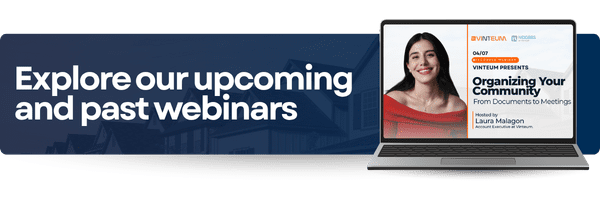
Here at Vinteum, we host free live webinars tailored specifically for everyday volunteers and property managers. We cover legal state updates and community organization strategies. You don’t need a background in property management to understand the material. We break down the complex legal jargon into plain English.
But remember: good boards know they aren’t lawyers. They consult an attorney before adopting new rules. They talk to insurance agents before signing high-risk contracts. Education teaches you exactly where your limits are.
How Do You Upgrade Your Board Operations After Training?
Education gives you the legal framework, but executing those duties requires the right tools. Replacing messy spreadsheets with a unified management portal ensures your community actually stays compliant and connected while cutting down your weekly administrative hours.
Once you get the education, you have to implement it. And that’s exactly where most boards hit a massive brick wall. Many boards struggle because they try to manage their new responsibilities using outdated spreadsheets or messy text messages.
You may have used other platforms that offer simple document storage and frustrating user interfaces. They usually just add more administrative work to your plate. When you’re trying to fulfill your fiduciary duty of transparency, you can’t rely on software that drops emails or hides architectural forms.
Neigbrs takes your operations to an entirely new level. Instead of a clunky portal, Neigbrs provides a highly intuitive experience that genuinely connects your community.
Our platform automates your violation tracking so you never lose a paper trail. It organizes your meeting records securely. Most importantly, it builds unparalleled trust through clear two-way community messaging. Having an educated board paired with the superior technology of Neigbrs is the optimal formula for a stress-free community.
Wrapping Up
Becoming a successful board member requires a blend of legal knowledge, patience, and absolute dedication. You stepped up to help your neighborhood, and that’s a noble thing. To truly protect your community, you must treat your role with the professionalism it demands.
Embracing continuous education protects you from the real threat of personal liability. It ensures your association’s finances remain rock solid. But education is only the first step. You also need the right tools to execute your vision. Don’t let your newly acquired knowledge get buried in messy spreadsheets.
Ready to put your education into practice? Find out how Neigbrs can automate your violations, streamline your accounting, and rebuild community trust in just 30 minutes. Let us show you how easy running your community can actually be.

Frequently Asked Questions
Is HOA board member certification legally required?
It depends entirely on your state laws. In Florida, new legislation mandates that board members complete a state-approved certification course within 90 days of election according to the text of Florida House Bill 1021. Even in states without strict mandates, legal professionals universally recommend training to avoid personal liability.
Do I have to pay out-of-pocket for HOA Board Education?
No. Industry advocates agree that continuous board training should be highly accessible. You can find these resources online for free through platforms like the Vinteum Webinar Hub. If an advanced course requires a fee, your association’s budget should cover it.
Do I need a background in law or property management to serve?
Not at all. Training programs are built specifically for laypeople, teaching you the fundamentals of reading financial reports and reviewing documents. The core lesson is learning exactly when to call a professional attorney or insurance agent so you aren’t guessing with community funds.