

HOA website templates are the fastest way for a volunteer board to get a real website online without hiring a developer or writing a single line of code. A few years ago, building even a basic community site meant weeks of back-and-forth with a designer and a bill that made most treasurers wince. Templates changed that math. Pick a layout, drop in your logo and a few photos, and the site can be live before your next board meeting.
That’s really the whole appeal. No coding knowledge required, no design degree, no outside vendor holding the keys to your own website. Anyone on the board, tech-savvy or not, can choose a design and load it with the community’s information.
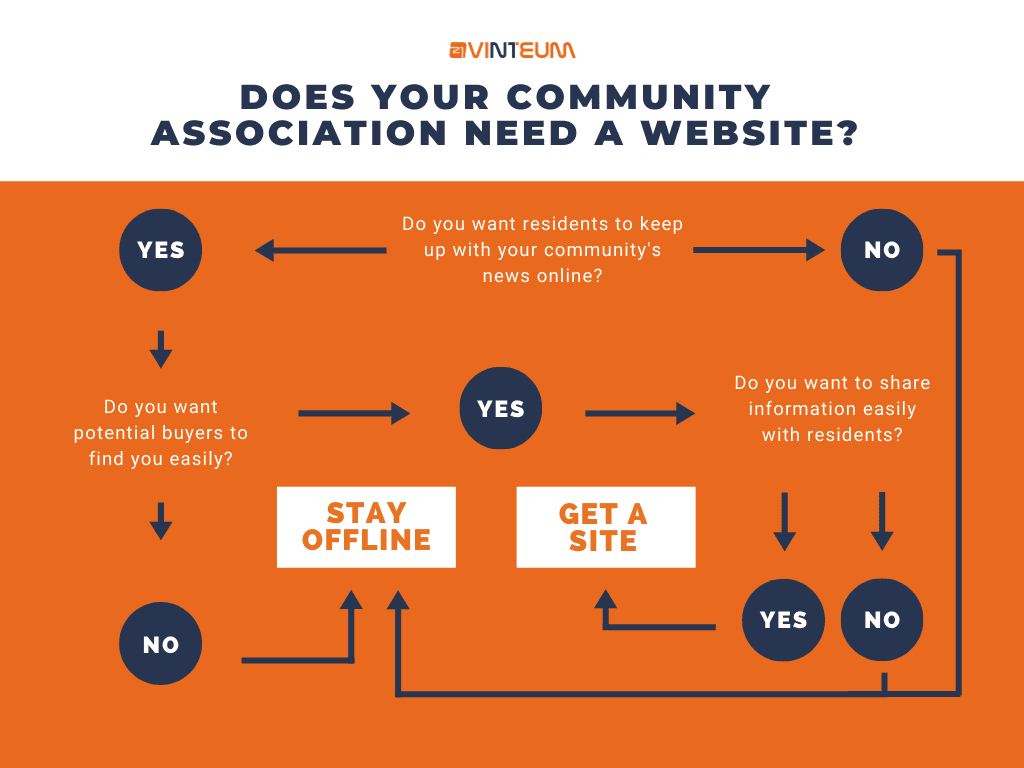
A functional, well-designed website is the backbone of an engaged community, and it’s often where a prospective buyer forms their first impression of your association, long before they ever knock on a door.

Why having an HOA website matters
Building trust with residents starts with your website. And in Florida, having one isn’t just good practice anymore, it’s the law for a growing number of associations.
Until 2024, Florida’s Condominium Act only required a website for condo associations with 150 or more units. That threshold dropped hard. Under an amendment to Section 718.111(12)(g) of the Florida Statutes, any condo association with 25 or more units, timeshares excluded, had to have a compliant website or downloadable app running by January 1, 2026. Homeowners associations weren’t spared either: Section 720.303(4)(b) requires any HOA with 100 or more parcels to post governing documents, budgets, and meeting notices online, a requirement that took effect back on January 1, 2025.
So if your community crosses either threshold, this stopped being optional a while ago. And if you’re reading this after those dates and still don’t have a site up, the obligation doesn’t wait for your next annual meeting. It applies the moment you cross the line.
Even communities well under those numbers get a real return on having a website. The Foundation for Community Association Research now counts more than 373,000 community associations in the U.S., home to over 78 million residents. That’s a lot of boards fielding the exact same three or four questions, on repeat, by phone and email and hallway ambush. A public FAQ page and a resident portal answer “where’s the pool schedule” once instead of fifty times.
What are HOA Website Templates?
Website templates are ready-made layouts your community can use and customize. A template comes with the structure, the features, and the overall design already built. Your job is just to add content: text, photos, documents, whatever your residents need to see.
HOA website templates differ slightly from generic website templates because they’re built around what communities actually need, not what a restaurant or a photographer needs. Think amenity reservation forms, a password-protected portal for members, or a directory that isn’t visible to the public.
They’re also customizable within reason. You can add your logo, swap in your own photos, change most fonts and colors, and rename sections to match how your community actually talks about itself. You won’t be able to redesign the template from the ground up, but you can absolutely make it feel like yours.

What are the key benefits of using HOA website templates?
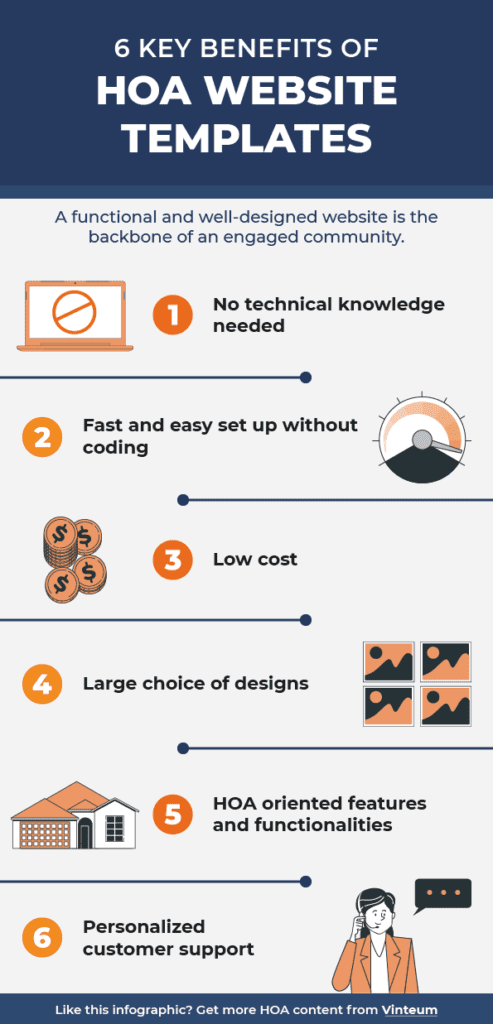
- The biggest benefit of an HOA website template is that nobody on the board needs to know how to code. You don’t have to be a designer or a developer to get one live. Anyone can do it, which matters a lot when your “IT department” is a retired accountant who volunteered for the job.
- Templates built specifically for community associations save you from adapting a generic small-business site to fit HOA needs. As a board member, you don’t want just any website. You want one that was built with associations like yours in mind from day one.
- Forget the months-long projects and the ongoing maintenance retainer once the site launches. With a template, you can go from nothing to a working website in a few hours, not a few months.
- Every HOA has something that sets it apart, whether that’s the amenities, the location, or the annual block party nobody wants to miss. A template gives you a place to show that off through photos and posts, which does double duty as a quiet sales pitch to prospective residents.
- Providers built for this space, Vinteum included, usually throw in a dedicated domain at no extra cost, meaning your site lives at yourcommunity.com instead of yourcommunity.someplatform.com. Most also pair that with a customer success team that helps with setup and fixes issues as they come up, which matters more than it sounds like it should when nobody on your board has ever run a website before.
How to use HOA Website Templates
Getting a template-based site live comes down to three moves. Choose your domain first, since that’s the URL residents and prospective buyers will actually type in. Then pick the template itself, ideally one built for community associations rather than a repurposed small-business design. From there, you add your logo and your content, and you can keep editing whenever the board decides something needs to change.
Vinteum, for example, offers six different community website templates to choose from, each with its own layout, and lets boards pick their sections, images, and text before the site goes live. If your association already has a domain, most providers can migrate it over rather than making you start from scratch.
Book a free demo to see how quickly this actually comes together once you’ve made your choices.
Where to find HOA Website Templates
There are plenty of options out there for HOA website templates, some paid and some free. Some providers bundle the template with a full resident portal, which turns the “website” into more of an all-in-one hub for the community rather than a static brochure. That combination benefits both current residents, who get one place to check documents and reserve amenities, and prospective buyers browsing from outside the gate.
Before picking anyone, get clear on what your board actually needs. List a few HOA website software options, then compare pricing, support, and whether the portal side of things is actually built to meet your state posting requirements, not just a nice-looking public page. A template that looks great but can’t password-protect the documents your statute requires isn’t solving the problem you set out to fix.
How to choose the best website template for your HOA
When picking a template, keep your actual residents in mind, not a generic buyer persona. A community with a lot of senior residents probably shouldn’t get a template with tiny fonts or clashing bright colors. Prioritize usability there over trendy design.
With so many templates available, narrowing it down can feel like a part-time job. The goal isn’t to find the flashiest option, it’s to find the one that reads like your community, not a stock photo of somebody else’s. For more direction, we’ve rounded up some of the best HOA website designs we’ve come across.
Frequently Asked Questions
Does a template automatically make my website legally compliant?
No, and this is the part most guides skip. A template gives you the layout, but compliance with posting rules depends on whether the provider actually supports a password-protected, members-only section separate from the public pages.
My community already has an old website. Can we switch to a template without losing everything?
In most cases, yes. Reputable providers can migrate your existing domain and, depending on the platform, help move over documents you’re required to keep archived. It’s worth asking specifically about this before you commit, since not every provider handles migration the same way.
Roughly how much do HOA website templates cost compared to a custom-built site?
Custom design work commonly runs into the thousands of dollars before ongoing maintenance. Template-based sites are usually a fraction of that, and some community management platforms bundle the website in at no added cost since it’s part of a broader software subscription rather than a standalone build.
If my association is under the 25-unit or 100-parcel threshold, do we still need a website?
Not by state law, no. But smaller associations still get real value out of one. It cuts down on repeat questions to the board and gives prospective buyers somewhere to look before they make an offer.
What happens if our association crosses the unit or parcel threshold after the compliance deadline?
The obligation kicks in immediately once you cross the line, according to legal guidance on the statute. Boards don’t get a grace period tied to the calendar year; if a new phase of construction pushes a condo past 25 units, the website requirement applies right away.
Wrapping up HOA Website Templates
Every HOA, regardless of size, needs a real website at this point, and templates are what make that realistic for a volunteer board with no design budget. They save money. They save board time. And for a growing number of Florida associations, they help keep the board on the right side of a statute that isn’t going away.
Understanding how they work is genuinely straightforward. You don’t need any technical background to update or add information once the site is live. With this many template options on the market, one of them will fit your HOA’s needs. The only real task left is choosing a design that reflects how your community actually lives, not just how it looks in a screenshot.
If you’d rather skip the comparison shopping altogether, Neigbrs by Vinteum bundles a fully customizable, compliance-ready website with the resident portal, document storage, and communication tools your board already needs, all under one login. Book a free demo to see it running on a real community, or grab the Condo & HOA Websites eBook if you’re still in the research phase.