

A homeowner association website gives your community an online focal point to share and receive information about what’s going on. It helps board members and property managers reach residents and vice versa. This article goes through why your community needs a website, how to make your website, and the five best HOA websites. Find out everything you’ve ever wanted to know about websites for your community and a little bit more.
The difference between an HOA website and an HOA portal
Before we get started, an important distinction to make is between a public website and a members-only password-protected area or portal.
A public website can be found by searching on Google, which means that anyone in the world can find it. So, you need to be careful what you post on there. No sensitive information should be displayed on your public website.
Then, you have a members-only space. This can be a password-protected part of your website or a portal that you can access from your website. Neigbrs by Vinteum offers a portal that can be accessed from your public website. If it’s an actual portal, you can have a more sophisticated system including violations, amenity management, and more.
However, if all you need is a place to share more sensitive information with members, then a password-protected part of your website should work fine. For this article, we’ll call it a portal to highlight that it’s different from your website.
Having A Website Is No Longer Optional
A website is no longer just a nice-to-have for community associations; it’s becoming a legal requirement. In Florida, the importance of a well-maintained HOA or condo website is so clear that the state has passed a law making it mandatory — read more about the Florida Condo Website Law here. As of January 1st, 2025, associations with 100 or more units are required to maintain a website with a residents portal to share key documents with residents, including governing rules, budgets, meeting notices, insurance policies, and contracts. And starting January 1, 2026, this requirement will extend to all associations with 25 or more units.
Other states, such as Nevada and Texas, also have laws regarding transparency and community websites. However, the goal behind these laws is simple: improve transparency, communication, and access to information. When residents can easily find what they need online, it builds trust and helps everyone stay informed and engaged.
That’s where Neigbrs comes in. Our platform makes it easy to keep your community compliant, organized, and connected, with a secure website, resident portal, and mobile app all in one. Book a free demo and get your community covered.
Why HOA Websites Matter
An HOA website offers numerous benefits to the board, property manager, owners, and tenants.
Help Communication
An HOA website gives the board a new channel to communicate with residents. It’s a useful one because most people know how to open a website so they can see what you post.
On your website, you should have an announcement or news section. There, you can post information that the whole community should know about. You should decide whether to allow comments on announcements. Your website should also include a contact form, allowing residents to easily message the board and ask questions.
If you wanted, you could create a blog for the board’s news and a separate section for residents’ updates. This highlights your residents’ achievements and community projects.
In your members-only portal, you should also have a forum where residents can talk to each other and ask questions.
When a board communicates with its residents, it creates trust and increases resident satisfaction, and a website is an efficient way to talk with owners and tenants alike.

Save time and money
How many different tools does your community have at the moment? Some communities that we speak to have Zoom, amenity booking software, package software, and automated call software as well as paying for an email service. Does this sound familiar to you?
Having a website and portal for your HOA can help you. For instance, Neigbrs by Vinteum offers a website and portal that include virtual meetings, amenities, packages, smart calls, texts, and emails.
If you have all of that in one place, you cut down on different software subscriptions and save time by having it all in one place.
Community Hub
Having a website for your HOA provides a dedicated space for your community to come together and share information.
Your community website is your place to share the HOA’s history, pictures of your community, and what you’re most proud of.
In your members-only portal, residents can share pictures they’ve taken and let their neighbors know what’s going on. You can share lists of recommended professionals to help other people out. As well as that, you can include a community calendar. Your residents need to know the maintenance schedule, activities, classes, and meetings.
FAQs and Documents
An essential part of having a community website and portal is having documents available. Putting documents online will cut down on the time the board spends sending people documents and make the HOA more transparent.
You should have an FAQ sheet that links to important documents and answers those repetitive questions. Then, organize everything into folders: Meeting Minutes, Projects, Newsletters, Finances, Forms, and so on. The easier it is to find files, the happier residents and the community association manager will be.
Organize your HOA
The main function that your community website can serve is to help the board and manager organize community life.
You can use a website to post news, documents, and events. If you have a calendar or just a list of events, this helps to keep residents informed of what is happening and when.
A portal is especially useful to do that as you can use it to help the board and manager in the HOA. It can manage amenity reservations, guest access, package pick-up, maintenance requests, and even parking.
HOA Websites Risks
There are two main risks that you need to consider when creating a website, which can be overcome quite easily.
Sensitive Information
The first one is having sensitive information, such as resident information, the HOA’s financial documents, or legal issues, available to everyone on your HOA’s site. You need to think about what will be available to whom.
For instance, you could have community event details available on your website, then keep meeting minutes on your portal so just members can see them. Then residents’ information could be available just to board members within your password-protected portal.
Open Forum
Another risk is using your community association website like a Facebook group or Reddit thread, where anyone can comment. While it is a good idea to provide an open forum in a private group, especially if it’s moderated, it can get out of control on your website, which is something that anyone can find.
Both of these risks are important to discuss with other board or committee members; however, they aren’t roadblocks. You need to be aware of them and consider them before building your great website.
How To Create Your Website
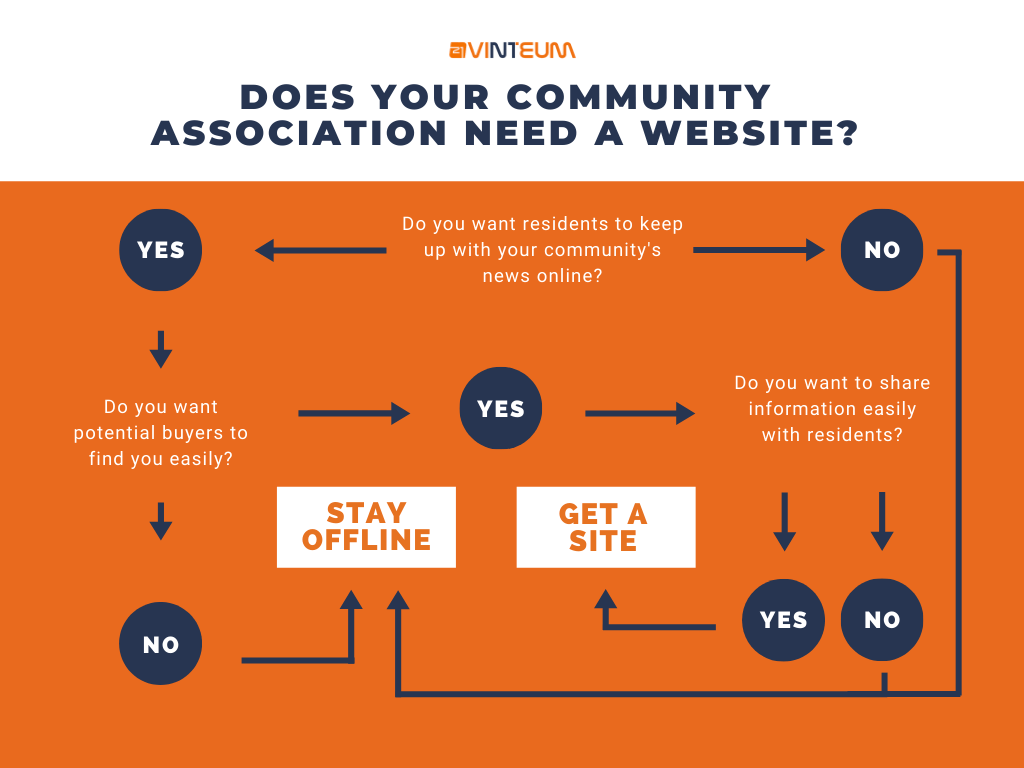
When you know that you need a website, how do you go about making one? In this section, we’ll talk about who should set up your website. Then, which platform should you use, and how do you choose a domain name? We go through setting up and designing your website without needing to code. Finally, we discuss how you add content to your website.
Who Should Make Your HOA’s Website?
If the board would like to build a website but doesn’t know how to, don’t despair. There are several options:
- Hire a freelancer to design a custom website for you. This is more expensive, but it does mean that you can set out exactly what you want
- Ask someone in the community. If you don’t have a board member who worked in software, then maybe a resident did and can help
- Hire a software company. There are a lot of companies, including Vinteum, that create HOA websites and software, which are easy to use.
- DIY. Use a website template to set up your website quickly and easily, without needing to code.
Choose a Platform
Before you create your community association’s website, you need to choose where you’ll host it. Different platforms allow you to use their templates to set up a website for your HOA. In the table below, we’ll go through the different options and their pros and cons.
| Solution Names | Benefits | Disadvantages |
|---|---|---|
| Squarespace | Great templates Beautiful design | More difficult to use |
| Wix | Easy to use Good customer support | Can’t change the design after publishing |
| WordPress | Incredible customization Lots of plug-ins | Have to set up a domain yourself |
There are other options available, but these are the three largest solutions if you want to create your community’s website without needing to code. If you’re going to dive deeper into these and other platforms to build your homeowners association website, explore here the top 3 builders.
Setting up your new website
When you’ve chosen which platform you’re going to use, it’s time to set up your community association website. There are lots of companies out there that make websites for you. If you go with a company that specializes in HOA websites, they can also provide you with a portal.
Having a portal is incredibly important as it provides a private space for your HOA members. If you can have a two-in-one website and portal, that is ideal for community life!
Designing HOA websites
The main decision when designing your website is choosing the template. Go through different templates and choose the best one for you. Don’t forget that you can change all the content; what you want to look at is the layout. Your layout changes the focus of the website.
If you move forward with a freelancer, then be clear on what the most important parts of your website will be. However, if you go with a company, ask them what templates they have and see exactly what their websites offer.
Add content to your new website
Even more important than the template you choose is the information you add to your website. The top three most important parts of your website are:
- The community’s name
- A contact form
- The most important documents
You can also include your HOA’s board members, property managers, what’s in the area, what makes your community special, and news (eg, projects, rules, meetings).
You could also ask residents what they would like to see on their community website. This can be helpful for you to direct the project.
Choose a Domain name
A domain name means that your website would be personalized, so instead of being communityname.nameofprovider.com, it would be communityname.com.
With WordPress, you need to purchase the domain name separately and then link it to your new website. If you choose Wix or Squarespace, they include a custom domain name. If you already own a domain name, then you can still point it to your new Wix or Squarespace website. With a company, you can buy a domain and transfer it to them, or they can buy it for you (normally for a small fee).
Here we’ll go through some different software platforms where you can buy domain names:
- GoDaddy: They’re the biggest player in the market; they have over 50 million domains registered. It’s easy to use and has a nice design.
- Namecheap: Namecheap’s renewal prices are lower than GoDaddy’s on the whole. Their privacy package is free, and I find that you wait less to speak to their support team.
- The 12 Best HOA Communication Tools of 2024
These three platforms let you add emails that would be [email protected]. When you buy a domain, you need to link it to your new website by changing the domain’s advanced settings to point to your new website.
If you want to look deeper into how to create an HOA website, take a look at this article explaining step by step the creation of HOA sites.
Templates for HOA Websites
Using the solutions mentioned above, you can use a template that they have to create your website, and it’s a great way to set up your website quickly, and cheaply.
However, there is a better solution, which is to use website templates made for HOAs. That means that the template was built with HOAs in mind so that you don’t have to fit a generalized template to your needs, you just fill this one in with your community’s information and pictures.
What are the Benefits of Using an HOA Website Template?
Using website templates for HOAs have benefits that generalized templates can’t offer. Discover the top 3 benefits:
1 – HOA Oriented Features
HOAs require features that average website templates might not include. These could be amenity reservations or maintenance requests. Having a template made for HOAs means that the layout and different sections will be more appropriate for the community association and its residents.
As we mentioned above, a clear division between your public website and private portal with more sensitive information is important.
2 – Dedicated Support
Template providers that work with community associations, such as Neigbrs by Vinteum, provide dedicated, personalized support to their clients to make sure that they’re getting the most out of their HOA websites.
At Neigbrs by Vinteum, we help you set up your website and get all your information the way you want it. Setting up your website is simple, but it can still feel overwhelming, and we’re here to help every step of the way.
3 – No coding needed
The idea of an HOA website template is that anyone can choose from pre-set designs to create a beautiful, modern, easy-to-navigate internet presence. You don’t need to know how to code; you just choose text and images and click on save.
You can have a high-quality website up in a few hours for your whole community to enjoy.
HOA Website Templates, Providers & Features
Using software comparison sites, like Capterra, you can find the best website provider for your community. You can consider the price, reviews, and whether they offer what you’re looking for. This will help you decide what HOA website software is right for you.
One key difference between providers is how they deal with security. It’s essential to maintain the confidentiality of certain information and ensure it’s accessible only to HOA members and residents. There are 2 ways to do that:
- Password-protected parts of your website. This means that when you click on a restricted item, it will prompt you to enter your login information. This can be confusing, as it is less clear what is public and what isn’t.
- As we mentioned above, we recommend a dedicated, password-protected portal. This is a separate tab in your website that leads to a private portal, where everything is password-protected, and the board chooses who has access. You could give access to all residents, or just to owners. This is safer because there is a clear division between your public site and private portal.
Creating Senior-Friendly HOA Websites
It’s important that your website is accessible to all members of your HOA, including senior residents.
High Contrast
The first step to a senior-friendly HOA website is to choose a template that has high-contrast colors, for instance, black text on a white background. Try to avoid using yellow, green, or blue, as these are harder to see as our vision decreases.

Clear Menu
When you’re setting up your menu, create it in a way that makes it easy to navigate your website. You can use a technique called breadcrumbs, which is text at the top of the page where the user can click to go back. This makes your site easier to navigate.
Large Clickable Items
When you add a button or hyperlinked text, make sure that it is a good size, so that people can easily click it.
Provide Clear Instructions
When you launch a new website, you should provide instructions in a video or a PDF document that shows your residents how to use their new website. At Vinteum, we provide a training manual and videos. We also offer ongoing personalized training for board members during our white-glove onboarding process.
The Five Best HOA Websites
We reviewed a lot of community association websites to find the top five HOA websites to provide you with some incredible examples of what you should include in your website.
Stonegate Country Club
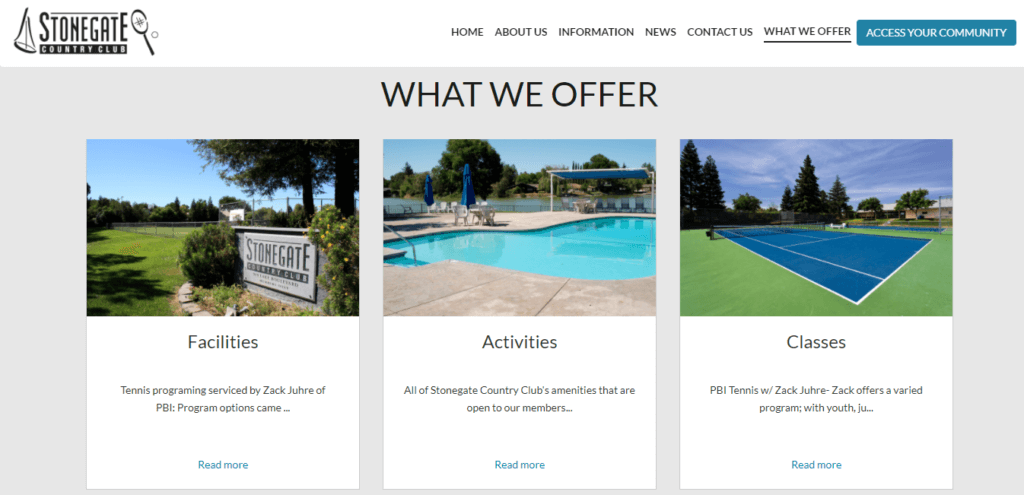
Stonegate Country Club is located in California, and it’s a beautiful association with incredible amenities and a lake.
What We Love
We love that they regularly update their website with news, including events for residents, how to log in and use their member portal. They also have information on their property management company, committees, and board members easily accessible.
Our favorite part might be ‘What We Offer’, which showcases their facilities, activities, and beautiful outdoor spaces.
What Could Be Improved
Nothing! This is an incredible website that has beautiful images, helpful information for residents, and entices prospective owners.
Beau Chêne
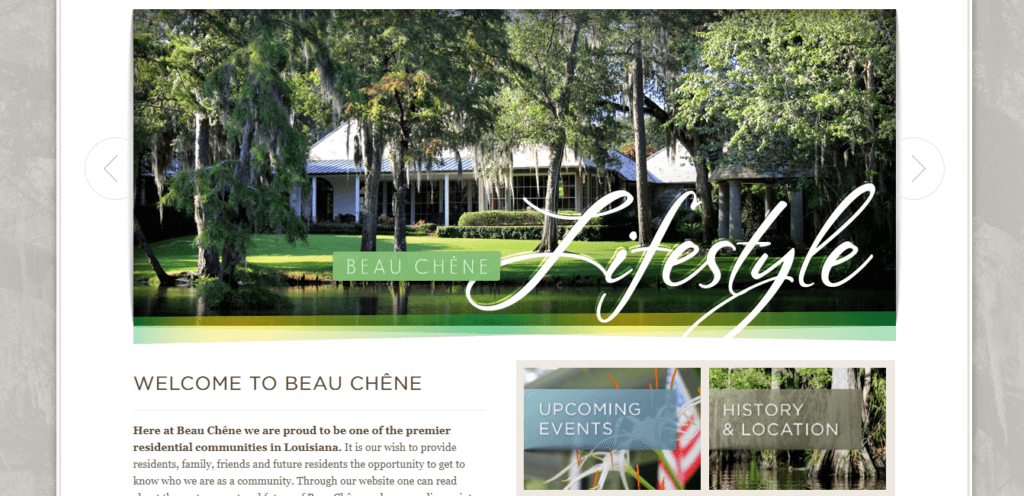
This Louisianian community’s website has absolutely everything that buyers and residents would need to know about the community, and a bit more.
What We Love
Beau Chêne’s HOA website examples are beautiful, and the photos are stunning. It gives you a real feel of the community, and it also gives insight into the history of the property. This is fascinating when your community has such a rich history. All the information that would interest buyers and that residents could need is right there on the website.
The news section is informative and gives you a sense of community within Beau Chêne. The website appears to reflect the community’s spirit, which is a great tool to promote your HOA. They also have their Facebook page linked to their website. Having a Facebook page promoting your HOA is an excellent way to keep in touch with residents and also make your HOA known.
What Could Be Improved
The website could have a more modern look. The home page has a lot of places to click, and too much choice confuses visitors. If we could give Beau Chêne one piece of advice, it would be to have one or two main buttons on the home page. The rest should be in the menu or the footer.
Walden Lake Community
Walden Lake is a rural community in Florida, and its website focuses on the green spaces in the community.

What We Love
The simplicity of this website is what makes it one of the best. They make the outdoors their selling point, making it a very attractive-sounding HOA. It doesn’t show any of the buildings, instead, the website focuses on their stunning lake and incredible wildlife. It has maps of all the different neighborhoods and a small description of each one.
What Could Be Improved
The biggest problem with the Walden Lake Community’s website is that it’s not the most intuitive website. The information is very spread out and hard to find. Also, having a picture behind the website’s information is distracting.
Aragon Neighborhood Association
Aragon Association’s website includes beautiful pictures, and their lifestyle and amenities sound amazing.

What We Love
That home picture is great quality, they reach prospective buyers and residents through their website. They include a FAQ, which is always useful, and their wonderful amenities. As well as that, they talk about their architecture and buildings which is wonderful to satisfy curiosity.
What Could Be Improved
Aragon could include pictures of their amenities and more information on what’s going on in the community.
Park Lido Townhomes HOA
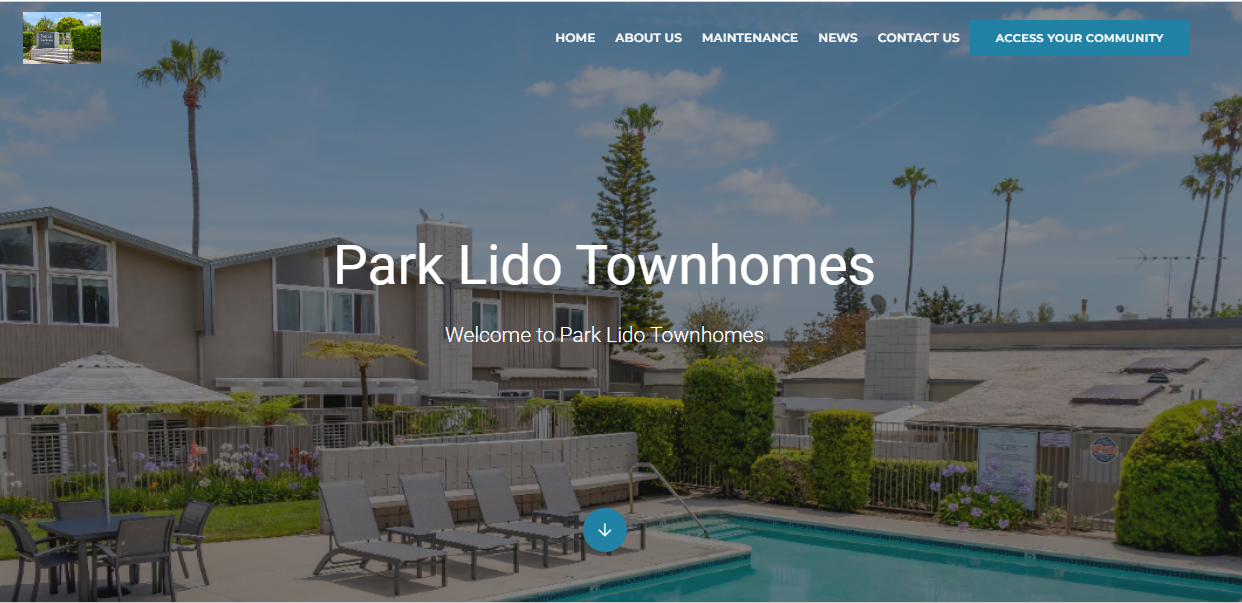
Park Lido Townhomes with stunning secrets, which is attractive for potential buyers and makes residents feel proud of where they live.
What We Love
That first picture is gorgeous, and the quality of the photos continues in the image gallery. Their description is complete, which talks about the houses and community, which is useful for possible new owners. It also talks about their management company, which includes contact information for residents.
They have information on community improvements and local news, the new website uses, as well as a roof replacement, vendors, and the architectural request form. All of this is key information for residents, which makes it a community hub.
What Could Be Improved
It would be nice to have more pictures of the townhomes and to include any houses that are for sale or rent. Other than that, it’s an incredible website.
Community Websites for Property Management Companies
If your community is professionally managed, there’s an important distinction to make: property management companies (PMCs) often handle two types of websites. First, there’s the PMC’s own branded website, which is key for their business. It’s how they’re found online, build trust with boards, and showcase the communities they manage. Think of it as their digital portfolio, it helps boards feel confident choosing them.
Then there’s the community website, created for each HOA or condo. This site carries the community’s name, logo, and updates, as announcements, events, and documents, and can include a password-protected resident portal, which some states even require. These sites help boards and PMCs communicate better, reduce confusion, and keep everything organized in one place.
If you’re part of a PMC or are helping one choose tools, check out this article with six great tips on what makes a strong management company website.
Do You Need Help Creating HOA Websites?
Now you know everything about HOA websites, it’s time to make one! If you don’t want to create your community’s website yourself (we know, is a lot of work), we can help. Neigbrs by Vinteum is the best HOA website builder, providing you with an easy-to-use, modern community public-facing website and portals. You tell us what you would like, and what’s important in your community, and we help you achieve that.
When you first sign up, we take care of the heavy lifting for you. Uploading your residents, setting up your website, and adding your documents, as well as amenities and service requests. Then our customer success team teaches you how to use the software. We offer six different website templates, allowing your website to reflect the unique character of your community.
Sign up for a free demo to find out how we can help you improve communication with a website and portal.

Frequently Asked Questions
Does an HOA actually need a website in 2025 and beyond?
In several states, an HOA website is now a legal requirement rather than a preference. Florida leads the country in HOA website legislation: as of January 1, 2025, associations with 100 or more units were required to maintain a website with a resident portal for sharing governing documents, budgets, meeting notices, and contracts, and that requirement extended to all associations with 25 or more units starting January 1, 2026. Nevada and Texas have also passed transparency laws that effectively push communities toward maintaining an accessible online presence. Beyond legal compliance, a website has become the baseline expectation residents have for any organized community, and associations without one are increasingly seen as difficult to communicate with and harder to trust
What is the difference between an HOA website and a resident portal?
A public website is searchable on Google and accessible to anyone, including prospective buyers, real estate agents, and current residents who want to learn about the community. Because it is publicly visible, it should never contain sensitive information such as resident personal details, financial documents, or legal correspondence. A resident portal is a password-protected space, either as a separate section of the website or as a dedicated platform linked from the homepage, where only verified members can access private documents, participate in community forums, submit maintenance requests, and manage amenity reservations. The distinction matters because treating both as the same thing leads to either oversharing sensitive information publicly or unnecessarily restricting content that would benefit prospective buyers.
What must an HOA website include to be genuinely useful for residents?
The most essential elements are the community’s name and identity, a contact form that allows residents to reach the board directly, and organized access to the most important governing documents. Beyond those core requirements, a well-functioning website should have a news or announcements section that is updated regularly, a community calendar covering maintenance schedules, meetings, and events, and a clear pathway to the resident portal where more sensitive information lives. Communities that also include a FAQ section linked to relevant documents dramatically reduce the volume of repetitive questions the board receives, freeing up board member time for higher-priority decisions. Real-world examples like Stonegate Country Club and Park Lido Townhomes demonstrate that the most effective HOA websites combine strong photography, practical information for residents, and enough community identity to attract prospective buyers at the same time.
What platform should an HOA use to build its website?
The right platform depends on the community’s technical comfort level, budget, and long-term needs. General website builders like Wix, Squarespace, and WordPress are accessible and well-documented, but they require the board to manually adapt generic templates to the specific context of a community association. HOA-specific software platforms, including Neigbrs by Vinteum, offer templates built around the features a community actually needs, such as document organization, amenity management, resident portals, and maintenance request tracking, without requiring any coding knowledge. A dedicated HOA platform also comes with the advantage of ongoing customer support that understands the governance context of the communities it serves, which a general website builder’s support team cannot replicate. For communities that are professionally managed, a property management company will often manage both the community’s website and their own firm’s website, making it practical to choose a platform that handles both use cases within a single subscription.
What are the biggest risks of running an HOA website and how can they be managed?
The two primary risks are inadvertent exposure of sensitive information and loss of control over community conversations. Because a public HOA website can be found and read by anyone, posting resident personal data, private financial statements, ongoing legal matters, or internal board communications on the public-facing side creates a real liability for the association. The solution is a clear structural separation between the public website and the private portal, where the board controls exactly who has access to what and sensitive documents never appear on the publicly searchable side. The second risk is allowing open, unmoderated commenting on the public website, which can escalate quickly into the kind of hostile or defamatory content that damages community reputation and creates legal exposure. Restricting community discussions to a moderated, private forum within the resident portal, rather than allowing open commenting on public pages, contains that risk without eliminating the community-building value of resident conversation
How should an HOA make its website accessible to senior residents?
Senior accessibility is often overlooked in the design process but is critically important given that older residents frequently make up a significant portion of a community’s membership. The most impactful changes are choosing a high-contrast color scheme, typically dark text on a light background, using a large readable font, and building a navigation menu that is simple and clearly labeled rather than relying on icon-only menus or dropdown structures that require precise cursor control. Buttons and clickable links should be large enough to tap easily on a touchscreen and visible enough to distinguish from surrounding text. When a new website launches, the board should also provide a step-by-step guide in both video and written format that walks residents through the most common tasks, such as finding a document, submitting a maintenance request, or logging in to the resident portal.
Can a property management company use HOA websites as part of its service offering?
Yes, and doing so creates a meaningful competitive advantage for management firms. A property management company that provides each community it manages with a branded, professionally maintained website demonstrates a level of service and organization that self-managed alternatives cannot match. The management company’s own website functions as a portfolio showcase, where prospective client boards can see the quality of websites already running for communities under management, building confidence before any sales conversation takes place. Platforms like Neigbrs by Vinteum are specifically built to support this two-website model, giving the management company a branded public presence while simultaneously providing each community with its own distinct website and portal.