




HOA compliance means following the rules laid out in a community’s governing documents, the CC&Rs, Bylaws, and Rules & Regulations that every homeowner agrees to when they buy into the association. It covers everything from how tall a fence can be to whether a homeowner needs approval before repainting the front door.
Compliance exists to protect consistency across the community. A compliance program keeps the neighborhood looking and functioning the way everyone expected when they moved in, and prevents a single homeowner from carrying the cost of someone else’s ignored rule. That’s why compliance touches two different groups at once: it sets expectations for what homeowners need to do, and it sets legal obligations for what the board needs to follow when applying those rules fairly.

What Is the Difference Between Compliance and Enforcement?
People often use “compliance” and “enforcement” as if they mean the same thing, but they don’t. Compliance is the state a community is aiming for, a neighborhood where residents follow the agreed-upon rules without much friction. Enforcement is the mechanism a board relies on when that state breaks down, grounded in the governing documents that authorize rule enforcement, to bring a violation back into line.
That distinction matters more than it sounds. A board that treats every rule violation as an enforcement problem first tends to create friction with residents who would have fixed the issue on their own with a simple heads-up. A board that leads with compliance, and only escalates to enforcement when needed, tends to build more trust over time.
Think of compliance as the destination and enforcement as the road boards sometimes have to take to get there. Most homeowners never need that road at all. Understanding the difference is the first step toward running a program that feels fair instead of punitive, for residents and board members alike.
Why HOA Compliance Is Important
Every board member has heard the same complaint at least once: “Why does the HOA even bother enforcing this?” It’s a fair question, and it deserves a real answer beyond “because it’s the rule.”
HOA compliance exists because a community only works when everyone plays by the same set of expectations. Without it, the things that make a neighborhood feel cohesive start to erode one exception at a time. One unmowed lawn goes unaddressed, then a driveway fills with cars that shouldn’t be parked overnight, and soon the standard nobody enforced becomes the standard nobody expects anymore. Underneath all of that sits a fairness question that’s easy to overlook. When rules apply evenly, residents trust the process. When they don’t, even a small violation can turn into a dispute that follows the board for years.
What happens when enforcement quietly stops? The pattern tends to look the same everywhere. Neighbors start comparing notes about who got away with what. Small infractions pile up because nobody wants to be the one who finally says something. Board members get blamed for favoritism they never intended, simply because they let one thing slide and enforced another. Trust in the board erodes faster than any single rule violation ever could on its own.
None of this means compliance has to feel punitive. The healthiest HOAs treat it as a form of care for the community, something that protects what residents already value about where they live. A rule about curb appeal is really about property value. A rule about noise on a Tuesday night is really about the quiet everyone signed up for.
That’s the mindset worth carrying into the next section. Understanding why compliance matters makes the actual mechanics feel a lot less like bureaucracy and a lot more like something the whole community is doing together.
What Documents Define HOA Compliance?
HOA compliance is defined by a hierarchy of legal documents, primarily the CC&Rs, the Bylaws, and the Rules & Regulations. Each one governs a different layer of community life, and knowing which is which matters more than most residents realize.
CC&Rs (Covenants, Conditions, and Restrictions) sit at the top of that hierarchy. They’re recorded with the county against the property itself, which is why they carry more legal weight than the other two documents. CC&Rs cover the big-picture obligations tied to the land itself, what homeowners can build and how the property must be maintained. Because they’re tied to the property, they carry forward automatically to whoever buys the home next.
Bylaws work differently. They govern how the association itself operates, covering things like board elections and meeting procedures, including how HOA bylaws themselves get amended as the community’s needs change. A homeowner is unlikely to get cited for violating a Bylaw directly, since it functions as the board’s internal rulebook, separate from anything homeowners are expected to follow day to day.
Rules & Regulations sit at the most flexible layer, covering day-to-day specifics like trash can placement and quiet hours. Boards can usually adopt or update them without a formal amendment vote, which makes this the layer that changes most often as a community’s needs shift.
When documents conflict, the CC&Rs win. A Rule can’t override something the CC&Rs already established, and neither can the Bylaws. If a board wants to change something at the CC&R level, that usually requires a formal amendment process and a supermajority vote from homeowners, which is intentionally harder than updating a Rule.
Who creates each document also varies. Developers typically draft the original CC&Rs before the first home sells. The board adopts and updates Bylaws and Rules & Regulations going forward, and many associations now run that amendment vote through electronic voting software to make it easier to reach the quorum a CC&R change usually requires.
Understanding this hierarchy is what makes the rest of the compliance process make sense. Every step of the compliance process, from the first notice to a final fine, ultimately traces back to one of these three documents.
How Does the HOA Compliance Process Work?
Most compliance issues start the same simple way: someone notices something. It might be a manager doing a routine walk-through, or a neighbor who finally decides to send in a photo. Either way, that’s the moment the process begins.
The compliance workflow, step by step:
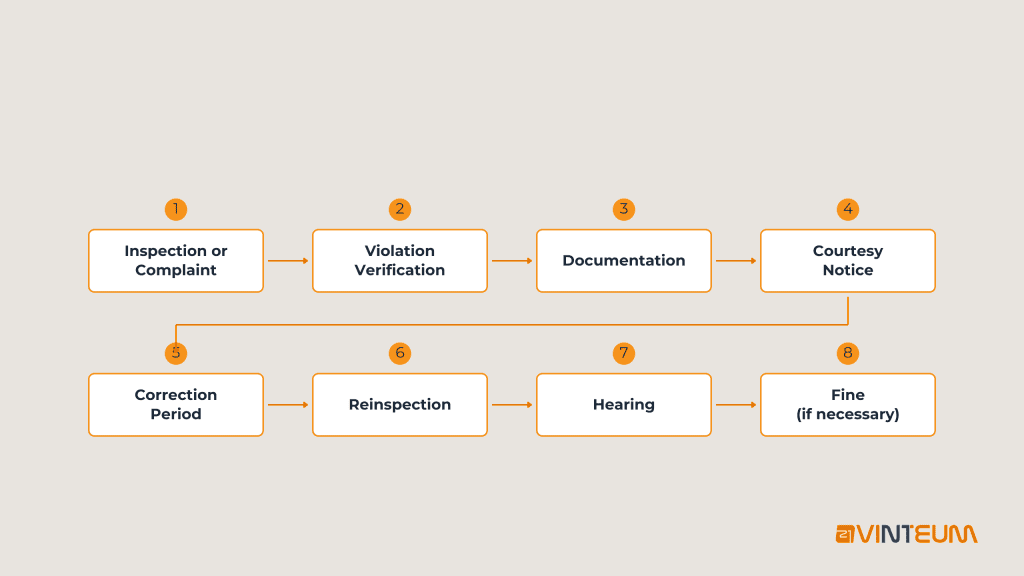
Here’s what actually happens at each stage:
Identifying a violation
Violations get flagged in two ways. A manager or a designated compliance inspector spots it during a scheduled inspection, or a resident reports it directly to the management company or board, often through an online violation report form instead of a phone call or a note in someone’s mailbox. Most associations accept complaints from any homeowner, though many require the complaint to include a photo or a specific description rather than a vague concern.
Verification and documentation
Not every complaint turns into a violation. Before anything moves forward, someone has to confirm the issue actually breaks a rule in the CC&Rs or Rules & Regulations, not just a neighbor’s personal preference. Once verified, it becomes part of the community’s incident and violation reporting record, complete with a timestamped photo and a reference to the exact rule that applies. This record matters more than most boards realize. If a case ever reaches a hearing or gets challenged as selective enforcement, this documentation is what protects the association.
The Courtesy Notice
A Courtesy Notice is the first formal communication sent to the homeowner. It’s intentionally low-key. It states the violation and references the rule, then gives the homeowner a deadline to fix it, without opening with a threat of fines. The tone here shapes the entire relationship. A notice that reads as an attack tends to produce a defensive homeowner. A notice that reads as a heads-up tends to produce a homeowner who just fixes the problem.
The correction period
Homeowners typically get somewhere between 10 and 30 days to resolve a violation before the process can escalate. That window comes from a legal floor set by state law, which the association’s CC&Rs can extend but never shrink. States like California and Florida spell out their own written notice requirements and cure periods in statute.
Reinspection
Once the correction period ends, someone checks the property again. If the issue is fixed, the case closes and nothing else happens. If it isn’t, the process escalates.
The hearing
A hearing gives the homeowner a chance to explain their side before any fine gets applied. This isn’t optional in most states, and skipping it is one of the fastest ways an association ends up with a fine that doesn’t hold up if challenged. The board or a designated compliance committee reviews the documentation, hears from the homeowner, and decides whether the violation stands.
When fines apply
Fines usually come into play only after the hearing confirms the violation and the homeowner still hasn’t corrected it. Boards that fine before a hearing, or without clear documentation, are the ones most likely to run into a selective enforcement defense later. That’s also where the Fair Housing Act becomes relevant. If a violation involves a modification tied to a disability, like a ramp or a service animal, the board needs to check whether a reasonable accommodation applies before treating it like a standard case.
The whole sequence can feel long on paper, but most violations never get past the Courtesy Notice stage. Most homeowners fix the issue as soon as they know it’s on someone’s radar.
Who Is Involved in the Compliance Process?
Compliance rarely runs through just one person. Each role handles a different piece of the process, and knowing who does what keeps a violation from falling through the cracks.
The Board holds final authority, approving the community’s Rules & Regulations and deciding whether a violation escalates all the way to a hearing and a fine. Board members are also the ones legally accountable if the process skips a required step, like a notice period or a hearing.
The HOA Manager runs the process day to day. A manager coordinates inspections, sends Courtesy Notices, tracks correction deadlines, and keeps the documentation the board needs if a case reaches a hearing. In most communities, homeowners interact with the manager far more than with the board itself.
The Compliance Inspector does the fieldwork. This role, sometimes handled by the manager and sometimes by a dedicated inspector, walks the property, takes photos, and confirms whether a reported issue actually violates a rule in the governing documents. Their documentation becomes the evidence the rest of the process relies on.
Residents participate more than most people realize. Homeowners report violations, respond to notices, and sometimes serve on a compliance committee that reviews other residents’ cases. A community where residents see themselves as active participants tends to have far fewer disputes than one where compliance feels imposed from above.
What Are the Most Common HOA Violations?
Most violations fall into a handful of predictable categories, and a few of them account for the bulk of every board’s caseload.
- Landscaping violations top the list almost everywhere: dead lawns or hedges that haven’t been trimmed in months.
- Parking issues follow close behind, especially unregistered vehicles sitting in driveways and cars parked on the street overnight in communities that restrict it.
- Exterior maintenance covers the physical condition of the home itself: peeling paint or a roof that’s fallen into disrepair.
- Trash violations are usually about timing and visibility, cans left out past pickup day or placed somewhere the CC&Rs don’t allow.
- Pets generate steady complaints too, mostly around leash rules or breed and weight restrictions written into the governing documents.
- Noise complaints tend to come from neighbors rather than inspections, which makes them harder to document consistently than a landscaping issue a manager can photograph directly.
- Architectural modifications cause the most friction of any category. Fences, sheds, solar panels, and paint colors almost always require ARC (Architectural Review Committee) approval before installation, and skipping that step is one of the most common violations a board encounters, often from homeowners who didn’t realize approval was required in the first place.
The most visible categories, the ones a neighbor is most likely to notice and report, tend to be the ones that turn into a dispute between neighbors in the first place.
What Are the Biggest Compliance Challenges HOAs Face?
Running a compliance program sounds straightforward on paper. In practice, boards run into the same handful of challenges no matter the size of the community.
Applying rules equally is the hardest one to get right. A board that lets a favorite neighbor slide on a landscaping violation, even once, sets a precedent that undermines every future notice it sends to anyone else. This is where selective enforcement claims come from, and it’s one of the strongest defenses a homeowner can raise at a hearing. The fix isn’t complicated, but it takes discipline: document every violation the same way, every time, regardless of who’s involved.
Avoiding favoritism goes hand in hand with consistency, but it’s harder for volunteer boards than it sounds. Board members live in the community they’re enforcing rules against, and they often know the homeowner getting cited personally. That familiarity is exactly why a documented, repeatable process matters more than good intentions. A board that keeps a written inspection log, and relies on it instead of memory or personal impression, protects itself and the homeowner both.
Reducing conflict matters just as much as winning a dispute. A hearing that turns adversarial tends to leave residents distrustful of the board long after the fine gets resolved, even when the board was right.
Balancing firmness with relationships is the challenge underneath all the others. Boards need residents to trust that rules apply evenly, but they also live next door to the people they’re enforcing those rules against. The boards that manage this best treat compliance as something the community does together, backed by clear documentation that keeps the process fair for everyone involved.

Frequently Asked Questions
Can HOA compliance enforcement violate the Fair Housing Act?
Yes. Denying a reasonable accommodation, like a service animal that exceeds a pet weight limit or a ramp that breaks an architectural rule, isn’t neutral enforcement. It’s a fair housing violation, so boards should review accommodation requests separately from the standard violation process.
What is selective enforcement, and how can a homeowner use it as a defense?
Selective enforcement is when a board cites one homeowner while letting the same violation slide for others, and it’s one of the strongest defenses a homeowner can raise at a hearing. Consistent photo documentation across every case is what protects the board from losing on this argument.
What happens if the CC&Rs and Bylaws conflict on a rule?
The CC&Rs almost always win, because they’re recorded against the property while Bylaws only govern how the board operates internally. A real conflict is worth a quick legal review before enforcing either one.
Does HOA compliance work the same way in every state?
No. The core sequence stays consistent: notice, correction period, hearing, and fine. But details like notice length and fine caps vary by state law.
How Technology Improves HOA Compliance
Most compliance headaches come from the same root problem: information scattered across emails and spreadsheets, with nobody quite sure where the latest version lives.
Take tracking. A manager used to log every inspection by hand in a spreadsheet, hoping nothing got missed between one walk-through and the next. Software now timestamps each violation and flags a correction deadline before it slips past anyone’s attention.
Notices work the same way. Once a violation gets logged, the Courtesy Notice can go out on its own, along with the follow-up if the deadline passes. That matters because delay is usually what turns a small issue into a real dispute. Nobody sent the letter for two weeks, and now the homeowner is annoyed for a reason that had nothing to do with the actual violation.
Digital records earn their value the day a case gets challenged. A board facing a selective enforcement claim needs to show it treated every violation the same way across the whole community, and a searchable digital history makes that case in minutes instead of an afternoon spent digging through old emails.
AI is starting to show up in the earlier steps too, flagging likely violations from inspection photos and turning a manager’s rough notes into something clean enough to bring to a hearing. A board still has to look at the case and make the call.
What software actually buys back is time, the hours a manager used to spend chasing down a record that should have taken thirty seconds to find.


