When HOA cybersecurity fails, the damage is usually decided in the first few hours, not the first few weeks. Yet many boards face their first incident without a plan. In an April 2026 survey by the Foundation for Community Association Research, only 14% of respondents said their community had one.
The habits that keep attackers out are covered in protecting your community’s information. This article starts where those habits fail. It walks a board through the first 24 hours of an HOA cybersecurity incident, from the first phone call to the message residents need to hear.
This article is for general informational purposes only and is not legal, cybersecurity, insurance or financial advice. Requirements vary by jurisdiction and circumstances. Associations should consult their legal counsel, insurance provider, financial institution and cybersecurity professionals as appropriate.
Money that leaves by wire doesn’t wait for the next board meetingBoard MeetingThe regular gathering where an HOA's board discusses community business and makes decisions.Read more →. In 2025 the FBI’s Recovery Asset Team was asked to chase $1.16 billion in fraudulent transfers and froze about $679 million of it, according to the IC3 2025 annual report. That process depends on victims reporting fast, and the FBI is blunt that every hour counts. Frozen doesn’t always mean returned, but nothing gets frozen without a fast report.
Now compare that with an HOA case Western Alliance Bank published. A management companyManagement CompanyA company that handles an HOA's day-to-day operations on the board's behalf.Read more →’s payables team got an email, apparently from an association’s community managerCommunity Association ManagerA professional who handles an HOA's daily operations alongside a volunteer board.Read more →, asking to pay the HOA’s $300,000 insurance premium by wire instead of check. The address was one letter off. Nobody noticed until the insurer’s representative showed up to collect the check, after two of three wires had already gone out. Less than 20% of the money had been recovered when the bank told the story.
The HOA Cybersecurity Incidents Boards Face Most
In the Foundation’s survey of 196 community association leaders across 37 states, 38% ranked phishing among their top cybersecurity risks and 28% named fraud or theft of association funds. Most incidents follow one of these patterns:
A redirected payment: someone impersonates a vendor, manager or board member and sends new bank details. Business email compromise cost victims more than $3 billion in 2025, per the FBI’s Internet Crime Complaint Center.
A compromised inbox: an attacker gets into an association email account and reads or sends from it, often to set up the payment fraud above.
A vendor breach: resident data leaks from a management company, accountant or software provider. In Verizon’s 2026 Data Breach Investigations Report, a third party was involved in 48% of breaches.
The response plan below covers all of them, but the redirected payment is the one where minutes matter most.
How to Build an HOA Incident Response Plan
An HOA incident response plan is a one-page answer to the question nobody wants to ask at 9 p.m. on a Friday: who do we call?
Start with the names: board president, treasurerTreasurerThe board member responsible for managing an HOA's finances.Read more →, community manager, association attorney, insurance agent and whoever handles IT. Add the fraud line for each bank the association uses. Then print it, because a hacked inbox may be the only place that contact list lives.
Next, decide who can act. Before anything happens, the board should establish who is authorized to contact the association’s banks and take emergency response steps, consistent with its governing documentsGoverning DocumentsThe full set of official rules, CC&Rs, bylaws, and regulations that govern how an HOA operates.Read more →, banking authorities and applicable law. The association’s attorney can help define those procedures in advance.
Last, check your coverage now. Only 25% of the Foundation’s respondents said their community carries cyber liability or data breach insurance. Ask your agent in writing whether a payment sent after a fake email is covered, and under which policy.
What to Do When a Payment Goes to the Wrong Account
This is the HOA paymentHOA PaymentThe fee homeowners pay to fund shared community upkeep and services.Read more → fraud scenario, and the order of steps matters more than how polished each one is.
Call the bank first. Ask for a recall of the wire or ACH and ask them to contact the receiving bank. The IC3 tells victims to do this immediately.
File the report. Submit a complaint at ic3.gov with the full transaction details, whatever the amount. Those reports are what the Recovery Asset Team uses to request freezes.
Secure the inbox. Change the password on the email account involved, sign out every other session and look for forwarding rules nobody on the board created. If the association’s email and bank accounts don’t have multifactor authentication yet, turn it on now.
Keep the evidence. Save the emails, invoices and bank confirmations. Don’t delete the fake message.
Call the attorney and the insurer. Do it before anyone posts about it in the community Facebook group.
Telling Residents and Meeting State Notification Rules
If resident personal information may have been compromised, state breach notification laws may apply. Every state has one, and they vary on what information is covered, who must be notified and how fast, according to a state-by-state overview from Jackson Lewis. Work with legal counsel to determine your association’s specific obligations. The board can still decide how the message sounds.
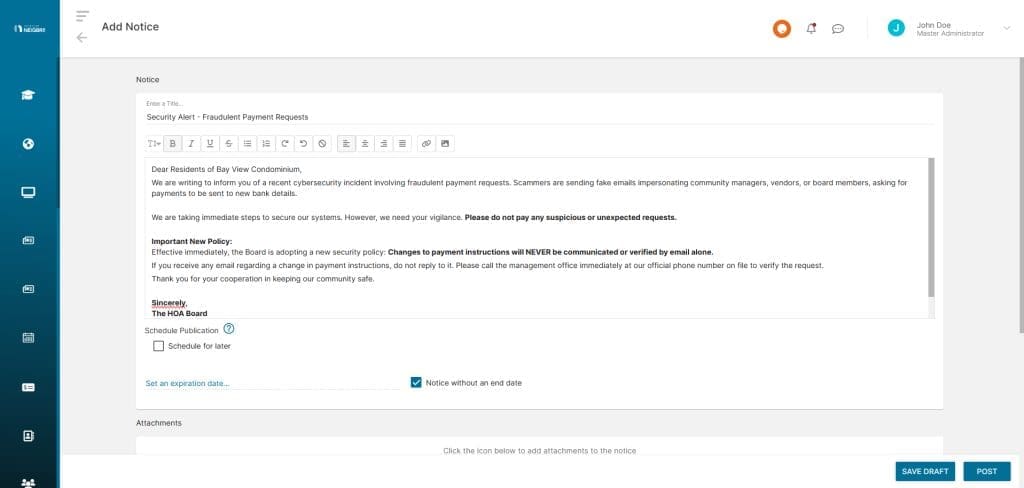
Don’t wait for the full picture to say something. Tell residents what happened and what the board is changing, in plain language. It also helps to adopt a policy that changes to payment instructions will never be communicated or verified by email alone, and to repeat it in every notice. Fraudsters already register lookalike versions of an HOA’s domain name to send fake assessment notices, and a resident who just heard about a breach is an easy target.
Close the Gap Before It Happens Again
Once things calm down, work out how it happened and change the rule that failed. Two fixes go a long way against HOA payment fraud. First, confirm any change to a vendor’s bank details by phone, at a number already on file, which is the first step Western Alliance Bank recommended after that $300,000 wire. Second, for vendors that handle payment-card data, ask for appropriate evidence of PCI DSS compliance where applicable, such as an Attestation of Compliance (AOC), the official PCI Security Standards Council form that documents their assessment. Only 21% of the Foundation’s respondents check a vendor’s security before signing.
How Neigbrs Helps Boards Communicate During an HOA Cybersecurity Incident
The hardest part of an HOA cybersecurity incident is often reaching every resident before the scammers do. That’s where our HOA software, Neigbrs by Vinteum, fits in.
With Neigbrs by Vinteum, the board sends notices and messages to the whole community from one place, so the warning about fake payment requests arrives through a channel residents already trust. Role-based access lets the board control who sees what, and association documents like bylawsBylawsThe rules that govern how an HOA's board operates, elects officers, and makes decisions.Read more →, minutes and budgets are stored in the platform instead of on a former treasurer’s laptop.
Neigbrs is hosted on Amazon Web Services (AWS) and uses encryption for data in transit.
Frequently Asked Questions About HOA Cybersecurity Incident Response
How fast should a board report an HOA cybersecurity incident?
To the bank and the FBI, the same day, because recovery odds drop as money moves between accounts. Deadlines for notifying residents depend on state law, so the association attorney sets that clock.
Can an HOA get stolen wire funds back?
Sometimes. In 2025 the FBI’s Recovery Asset Team froze about $679 million of the $1.16 billion it was asked to address, though frozen funds aren’t always returned, and the process only starts once someone reports. In the Western Alliance case, less than 20% came back.
Does HOA cybersecurity require hiring an IT company?
Not to write a response plan. About half (49%) of the Foundation’s respondents have dedicated IT support. The rest can line up a firm to call before they need one.
What should residents do with a suspicious payment request in the HOA’s name?
Not pay it. They should call the management office at a number they already know, forward the message, and report it at ic3.gov if money already went out.
My journey from web developer to International Marketing Specialist at Vinteum has been fueled by a deep fascination with how people connect. With a degree in Advertising and PR and a background leading creative teams, I am passionate about bridging the gap between cold data and human emotion. I possess a strong technical foundation that complements my experience leading creative teams and brand engagement projects. In the meantime, I like coffee and play with my cats.
My journey from web developer to International Marketing Specialist at Vinteum has been fueled by a deep fascination with how people connect. With a degree in Advertising and PR and a background leading creative teams, I am passionate about bridging the gap between cold data and human emotion. I possess a strong technical foundation that complements my experience leading creative teams and brand engagement projects. In the meantime, I like coffee and play with my cats.
Say goodbye to clunky systems. Neigbrs connects your residents and simplifies operations with an all-in-one platform and a beautiful website.
Manage Consent
To provide the best experiences, we use technologies like cookies to store and/or access device information. Consenting to these technologies will allow us to process data such as browsing behavior or unique IDs on this site. Not consenting or withdrawing consent, may adversely affect certain features and functions.
Functional
Always active
The technical storage or access is strictly necessary for the legitimate purpose of enabling the use of a specific service explicitly requested by the subscriber or user, or for the sole purpose of carrying out the transmission of a communication over an electronic communications network.
Preferences
The technical storage or access is necessary for the legitimate purpose of storing preferences that are not requested by the subscriber or user.
Statistics
The technical storage or access that is used exclusively for statistical purposes.The technical storage or access that is used exclusively for anonymous statistical purposes. Without a subpoena, voluntary compliance on the part of your Internet Service Provider, or additional records from a third party, information stored or retrieved for this purpose alone cannot usually be used to identify you.
Marketing
The technical storage or access is required to create user profiles to send advertising, or to track the user on a website or across several websites for similar marketing purposes.