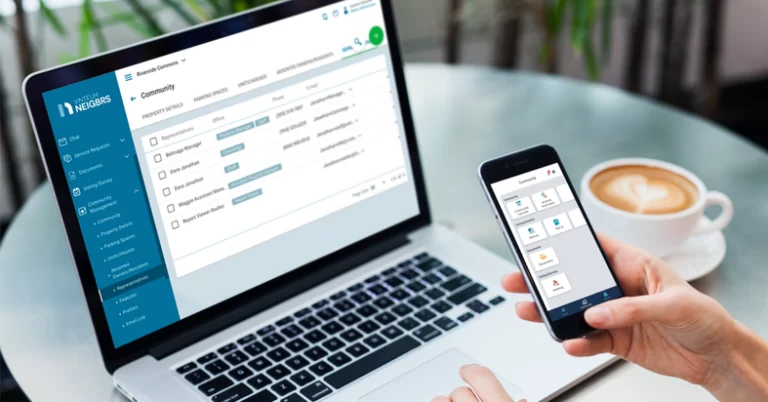



HOA management software is built to run community governance. It handles elections and bylaw enforcement, the kind of work a landlord-focused property management tool never touches. Financial oversight comes with it too, since a volunteer board can’t fake that with a spreadsheet. That distinction matters more than most buying guides admit, because a lot of boards start their search typing “property management software” and end up comparing tools built for landlords collecting rent, a different job entirely from running a volunteer board. The two categories look similar from the outside but solve different problems.
A property manager or board member dealing with this alone runs into the same results repeatedly: damaged common areas, unexpected maintenance bills, residents who fall behind on dues, and barely enough time left to think about anything strategic. That crunch is exactly what the right software is meant to relieve. This guide walks through what HOA management software actually replaces and the benefits boards feel first, then gets into how to choose the platform that fits your community.

What This Category of HOA Management Software Replaces
At its core, HOA management software replaces three or four disconnected tools with one: the spreadsheet tracking dues, the email thread serving as “communication,” the paper binder of bylaws and minutes, and often a separate, outdated community website nobody maintains. A modern platform folds all of that into one dashboard, plus a public-facing website residents and prospective buyers can actually find.
Boards that try to hold this together with a shared drive and a group chat aren’t wrong to try. But it’s a structure that breaks down as the community grows past a handful of units, because nothing in a group chat is searchable, auditable, or private the way governance records need to be.
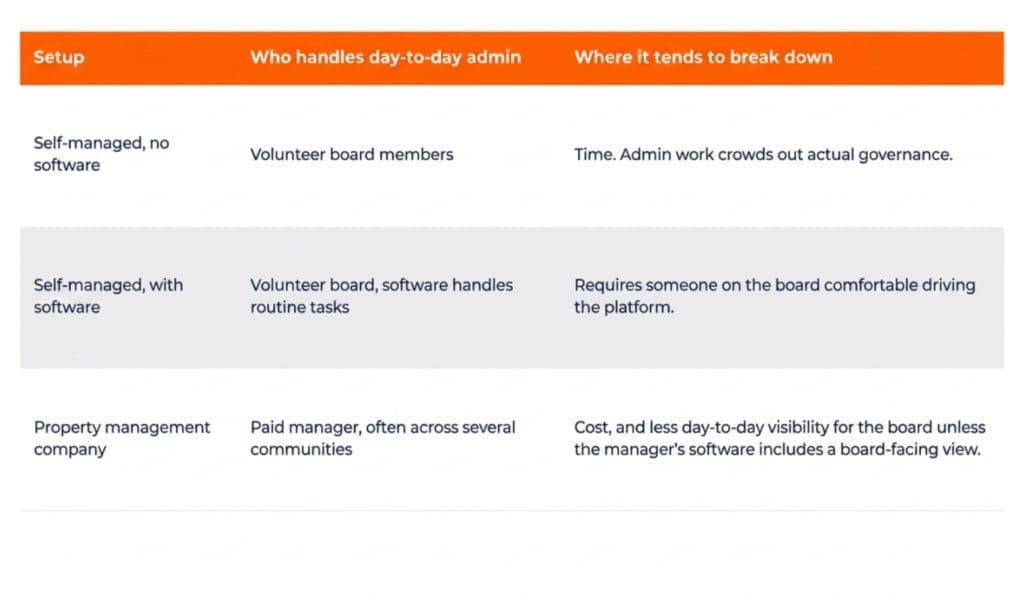
Self-Managed, Hire Help, or HOA Management Software: Which One Fits Your Board
Every board eventually faces the same fork: keep running things with volunteers alone, bring in a property management company, or add software to whichever setup already exists. These aren’t mutually exclusive, and that’s the part most comparisons skip. A self-managed board with software behind it can handle a surprising amount, since the platform absorbs the admin work a paid manager would otherwise bill for. A board that hires a property management company still benefits from software, since a manager working across several communities needs the same centralized records at a larger scale. The setup that struggles most is a self-managed board with no software, where every hour goes into paperwork instead of decisions.
The Benefits Boards Actually Feel
When defining your needs, you should take into consideration some aspects of your HOA. For example, the number of units, the number of amenities, if your residents are seniors or young families, etc. This will help you choose and prioritize what features can’t be missing. Here below we’ve listed some functionalities or benefits that we believe are vital.
Real-Time Access to Information
Records update the moment someone touches them, whether that’s a payment, a maintenance ticket, or a new resident record, and everyone with permission sees the same version at the same time. This matters more than it used to, since a growing share of board work now happens outside a physical office, from a kitchen table or a car between property visits. An HOA portal is what makes this possible in practice: instead of one person holding the master spreadsheet, the whole board and the property manager pull from the same live source, on desktop or mobile.
Stronger Communication with Residents
Every notice and meeting minute lives in one place residents can actually find, governing documents included. Nobody has to call the board desperately looking for the form to change a fence or request a maintenance visit. This is exactly the gap that Neigbrs’ Jotform integration for resident forms closes, turning a request that used to live in someone’s inbox into a form that routes itself. The same logic extends to document handling more broadly: boards that centralize document storage and stay current with new state laws avoid the scramble that happens when a resident asks for a record nobody can locate.
Easier Inspections and Maintenance
Coordinating a preventive maintenance schedule across a whole portfolio used to mean juggling paper checklists per property. With software, inspection dates go on a shared calendar residents can see, which builds transparency instead of suspicion about what’s actually being done. The same principle applies to shared amenities: when every resident wants the pool or the clubhouse on the same July weekend, an amenities reservation system turns a scheduling fight into a five-minute booking.
Real Control Over Finances and Payments
Instead of guessing who’s current on dues, HOA management software shows it in real time, along with what’s due and what’s overdue, and lets residents pay from their phone instead of mailing a check. That visibility also makes bigger financial decisions safer. A board about to take on a HOA loan for a major repair needs clean, current numbers to bring to a lender, and scattered spreadsheets rarely produce that on short notice. It also changes how a board handles scrutiny: when residents question where the money went, a board that can pull a clean HOA audit trail in minutes has a very different conversation than one that has to reconstruct it from memory. Book a free demo to see what that financial dashboard looks like with your own numbers loaded in.
AI Already Handles Some of The Busywork
The clearest use of AI in HOA software right now isn’t glamorous. It flags a maintenance issue before it turns into an emergency repair, and it helps with financial reporting and reconciliation, the same paperwork that used to eat a bookkeeper’s whole afternoon. That’s part of why AI automation is already standard in HOA management software rather than a novelty add-on. None of it replaces board judgment. A person still reviews the numbers before they go into a report, and legal guidance on AI in community associations is consistent on this point: software should support a board’s decisions, not make them.
Less Administrative Work Overall
This is the benefit every other one rolls up into. Routine tasks, like sending a reminder notice or logging a maintenance request, get automated, which frees the board and the property manager to spend time on decisions that actually need a human. A well-run HOA meeting is easier to hold when the admin work leading up to it didn’t eat the whole week, and boards that lean on ready-made community templates instead of building every notice from scratch save even more of that time back. For a fuller picture of whether your board should handle this in-house or bring in outside help, this HOA management guide is the place to start.
How To Choose The Right HOA Management Software For Your Community
Once a board agrees it needs software, the harder question is picking the right one out of a loud, crowded market. A five-step process keeps that decision from dragging on for months:
- Name the actual need. Is this mainly a communication problem, a financial-tracking problem, or both.
- Set a budget range. Do this before looking at a single vendor, since pricing conversations go faster once you already know your ceiling. A free HOA budget calculator is a reasonable starting point if the board hasn’t nailed down a number yet.
- Build a short list. Ask peer board members or property managers what they use, then cross-reference it against review sites like Capterra or SourceForge.
- Narrow it to two finalists. Compare price and features, then dig into what actual customers say about each in reviews.
- Book a live demo with each finalist. Skip the self-serve trial and talk to a real person instead.
A quick way to compare finalists side by side once the list is down to two or three:
That last step, the demo, is worth taking seriously on its own. A demo is a live conversation with the vendor’s team, which tells you far more about ongoing support than a trial ever will. So a trial shows you the software alone, with none of the people who’ll actually be answering your calls after signup. One board president, Oscar R., described the training he got during onboarding with Neigbrs as extremely helpful, and said the team stayed responsive to every question along the way, which is exactly the kind of thing a self-serve trial can’t show a board in advance. An annual HOA checklist is worth keeping on hand too, since a lot of what a new platform needs to track lines up with tasks a board already has to run every year.

What To Ask About Security and Migration Before You Sign
Every board eventually asks the same question in a slightly different way: where does our data actually go, and what happens during the switch. That hesitation is reasonable. Bylaws and financial records carry real weight, and so does resident data, which means moving them somewhere new deserves a deliberate plan, with real answers before the switch flips.
A platform built for HOAs treats compliance as a baseline requirement from day one, with access controls and audit trails that let a board answer “who saw this document and when” without a shrug. That’s a different standard than protecting community information generally, which is worth understanding on its own before assuming any cloud platform automatically covers it. If the community has any pending legal matter, it’s also worth checking with your HOA attorney on what records need to carry over intact, rather than assuming the new platform will sort it out automatically.
A Florida board member who switched to Neigbrs put it plainly in a review posted this year, calling it “a great software for Florida compliance” after less than six months of use. He described the setup as fast and the support as kind and responsive, and singled out how HOA management software handles documents storage right alongside the community website and e-voting, adding that Vinteum’s customer service is excellent once you find the right channel to reach the team.
That detail is worth sitting with. Documents and the website show up right alongside e-voting, in the same review, about one platform, because that’s how the board actually experienced the switch: as a single move.
Frequently Asked Question
Is HOA management software worth it for small, self-managed associations?
Yes, often more than for larger ones. A self-managed board without paid staff absorbs every admin task personally, so automating notices and payments alone returns real hours to volunteers, and record-keeping stops eating up the rest.
How much does HOA property management software actually cost?
Pricing is usually quoted per unit, per month, rather than as a flat fee. Neigbrs, for example, starts at $0.79/unit/month for a basic tier and scales up with features like mobile apps and digital voting, which makes it easier to size the cost to a specific community instead of guessing from a generic quote.
What’s the real difference between HOA management software and general property management software?
General property management software is usually built for landlord-tenant relationships: leases and rent rolls, tenant screening on top. HOA software is built around board governance instead, running elections and enforcing CC&Rs, with resident self-service folded in, which makes it a mismatch when a board tries to force-fit a rental-focused tool onto community governance.
How long does switching to a new HOA platform actually take?
This depends on data volume and how organized current records are, but the bigger bottleneck is usually resident adoption. The technical side itself is quick, generally around one to two hours of actual setup time, well under what most boards expect going in.
The Bottom Line
Property management software built for HOAs runs on board governance, elections and bylaw enforcement first, resident self-service close behind. Starting the search with that in mind saves a lot of wasted demos with vendors built for rental landlords instead. Neigbrs by Vinteum brings communication and daily operations into one dashboard, with the financial side handled in the same place. Backed by a 98% renewal rate across 226 associations and more than 28,000 units, request a free demo to see how it maps to your community’s specific setup.